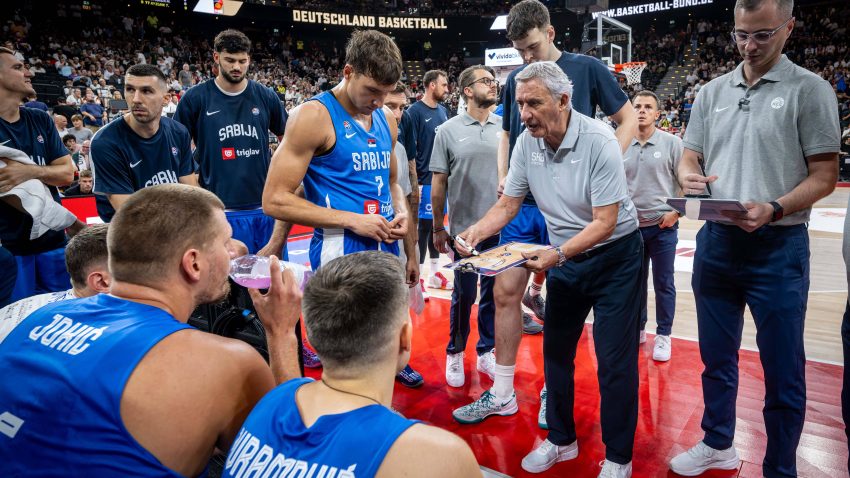
Serbia enters this summer with a point to prove. Since becoming an independent nation, its basketball team has yet to capture a coveted gold medal.
The heartbreak has been consistent—silver medals at EuroBasket, the World Cup, and the Olympics—but the top step of the podium has always slipped through their grasp.
That history fuels a lingering sense of unfinished business, a collective drive within Serbian basketball to finally break through.
What makes this opportunity even more compelling is the makeup of the roster. This is the so-called golden generation—players born in the early 1990s like Bogdan Bogdanović, Vasilije Micić, Nikola Jokić, Nikola Milutinov, and others who have proudly carried the flag for more than a decade.
Together, they represent the backbone of everything Serbia has achieved since the mid-2010s.
But with age creeping in, this might be the last chance for this group to be the undisputed leaders of a major tournament, and they enter it as clear favorites.
For them, this summer is more than another competition; it’s the perfect opportunity to crown everything they’ve given to the national team over the years.
Pesic’s New System: Building Around Nikola Jokic
After last year’s Olympic campaign in Paris, where they played tough but ultimately fell short of the gold, Svetislav Pesic has introduced a number of tweaks to both the playbook and the lineup.
The biggest change is simple to see: this team looks a lot more like the Denver Nuggets when Nikola Jokic is on the floor.
It’s not just about giving Jokic the ball more. It’s about putting him in positions where he can dictate the flow of the offense.
During the friendly games leading up to this summer, Serbia leaned heavily into actions that maximize Jokic’s ability to create for others.
That means more handoffs, more sets that start from the high post, and much more off-ball movement.
The playbook is filled with cutting, screening, and off-screen actions designed to generate constant ball movement, something Jokic thrives in.
The entire approach mirrors what makes him so unstoppable in the NBA: a system where everything runs through his vision, decision-making, and scoring threat.
The adjustments go beyond tactics—Pesic has also revamped Serbia’s starting lineup compared to last summer.
At the Paris Olympics, the team typically opened with Ognjen Dobrić at small forward, serving as the glue guy alongside Filip Petrušev at power forward and Jokić anchoring the middle. That setup provided a blend of perimeter defense, floor spacing, and interior size.
This summer, however, the strategy has shifted. Pesic has gone with a “big-ball” approach, sliding Nikola Jović into the small forward spot, keeping Petrušev at the four, and Jokić at center.
The trade-off is clear: instead of a defense-first wing, Serbia now features a towering front line. With Jović’s size and length on the wing, Serbia boasts one of the biggest lineups any opponent will see.
In many ways, Serbia’s latest adjustments feel like a natural progression. Last year’s squad was already strong, but Pesic identified room to elevate it further by leaning even more on Jokić’s unique strengths.
Early friendlies suggest the tweaks are paying off. Jokić looks at ease, the ball is flowing, and the offense carries shades of what makes the Nuggets so dangerous.
The gamble comes in Serbia’s commitment to size and versatility over the steadiness of a traditional glue-guy wing. That decision could shape their entire run: if defensive rotations stay sharp and Jokić continues to orchestrate as the hub, Serbia could be close to unstoppable.
Pesic has long preached team basketball, but this version is unmistakably constructed around Jokić. For the first time on the international stage, his role mirrors his NBA environment—and that alignment could make Serbia the clear favorite to finally capture gold.