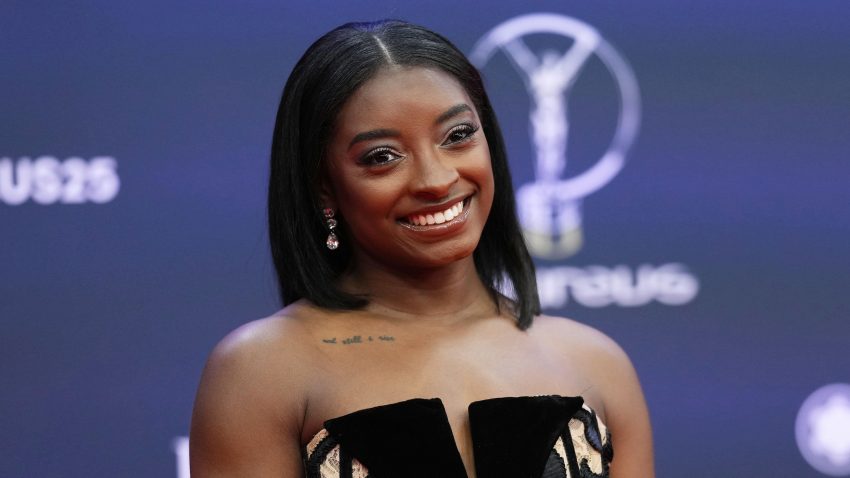
Simone Biles, the most decorated gymnast in history, has apologized following a heated online exchange with anti-transgender campaigner Riley Gaines. The social media confrontation unfolded after Biles criticised Gaines, calling her a “bully” and a “sore loser” over her continued campaign against transgender participation in women’s sports.
Gaines, a former competitive swimmer, rose to prominence in 2022 when she tied for fifth place with transgender athlete Lia Thomas in the NCAA 200m freestyle final. Since then, she has become an outspoken opponent of transgender women competing in female categories. She has sued the NCAA, testified before the U.S. Senate, and appeared alongside former President Donald Trump during the signing of an executive order aimed at excluding transgender athletes from women’s sports.
The recent clash began when Biles responded to Gaines’ criticism of a high school baseball team that included a transgender player. In a now-viral post, Biles wrote, “You should be lifting up the trans community and working to make sports more inclusive, not tearing others down. Nobody is safe in sport with your attitude.”
However, Biles later took a more conciliatory tone, acknowledging that her remarks may have crossed a line. “It didn’t help for me to make it personal,” Biles admitted in a follow-up message. “This is a deeply complex issue without easy answers, but what we need most is empathy and respect.”
The 28-year-old Olympic icon also called for governing bodies in sport to find balanced solutions that preserve both fairness and inclusion. “Sports organizations must take responsibility for setting rules that support inclusive participation while ensuring fair competition,” she said. Biles went on to suggest that alternative competitive pathways, such as dedicated transgender categories, could be explored. One such attempt by World Aquatics during the 2023 Swimming World Cup in Berlin was ultimately cancelled after no participants registered.
Although transgender inclusion in sport garners significant media attention, the actual number of openly transgender athletes is extremely low. NCAA President Charlie Baker stated in December that fewer than ten transgender student-athletes compete across the organisation’s 510,000-athlete pool.
According to figures from the City of San Francisco, transgender individuals account for around 1–2% of the U.S. population, but less than 0.002% of U.S. college athletes and just 0.001% of Olympians.
Despite this, controversies continue to arise. In boxing, two female athletes, Imane Khelif and Lin Yu Ting, were permitted to compete at the Paris Olympics despite previously failing gender verification tests issued by the International Boxing Association. The IOC disavowed the IBA’s process, deeming it unreliable and reminiscent of outdated, invasive practices. The incident drew widespread attention and was later used in political messaging during Trump’s campaign.
Khelif, in particular, became the target of online abuse, prompting her to file a harassment lawsuit in which she named Donald Trump among the parties responsible for inciting the bullying.
As the debate over transgender inclusion in sport continues, athletes, governing bodies, and policymakers remain divided on how to move forward—balancing fairness, science, and human dignity.