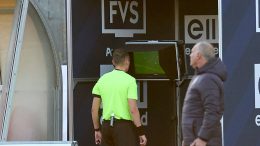
In a recent televised discussion on TVM Sports Plus during the Monday night analysis programme Il-Kampjonat, Hamrun Spartans President Joseph Portelli raised pressing concerns regarding the state of refereeing in Malta’s top-flight league. The debate has further ignited discussions over the Malta Football Association’s (MFA) approach to implementing Video Assistant Referee (VAR) technology.
Portelli, a key stakeholder in Maltese football, stressed the urgent need for Maltese referees to have access to VAR. In his view, the level of officiating in Malta has failed to keep pace with the significant financial investment being poured into the league. “Given the money spent on our league,” Portelli argued, “Maltese referees should have been the first to adopt VAR. It’s no longer an option but a necessity.”
Calls for International exposure and continuous training
Portelli did not stop at advocating for VAR but also called for Maltese referees to participate in regular international exchanges and advanced training courses. “Referees need constant exposure to high-pressure environments outside of Malta to refine their decision-making skills and adapt to evolving football standards,” he remarked.
In a step towards potential VAR implementation, the MFA organised an introductory seminar on Friday, 25 January, led by David Elleray, the Director of the International Football Association Board (IFAB). Elleray, a respected figure in global football governance, provided an overview of VAR protocols and technical requirements. Notably, he encouraged Maltese referees to begin integrating VAR-like communication techniques into their match-day operations, even in the absence of the actual system.
Elleray instructed the referees to start communicating as if VAR is in place, emphasising the importance of preparation and familiarisation. Following the seminar, Alan Mario Sant, Chairman of the Refereeing Department, held a supplementary session for elite assistant referees. Sant reportedly underscored the need for enhanced concentration during matches, particularly in offside decisions and other critical situations where human error is most prevalent. Sant warned that consistent performance is necessary in future matches.
His sentiment was echoed by Dr Kevin Deguara, Honorary President of Żabbar St. Patrick’s FC, who expressed a more measured but equally supportive stance. While acknowledging that “to err is human” and that mistakes are an inevitable part of officiating, Deguara highlighted the importance of VAR in minimising errors. He described the introduction of VAR as a matter of “when, not if,” pointing out that a variety of cost-effective systems are now available on the market.
Financial implications and strategic priorities
Despite the clear push from key figures, the implementation of VAR in Malta will require a significant financial commitment. Critics of the MFA argue that prioritising infrastructure and development projects over officiating enhancements may leave the league lagging behind its European counterparts.
However, proponents of VAR insist that it is an investment in the league’s long-term credibility. Portelli’s assertion that “football revolves around money” resonates with many within the local football community, who see VAR as not just a tool to correct errors but a means to protect the integrity of the league and attract further investment.
For the MFA, the path forward involves balancing financial constraints with the urgent need to modernise officiating standards. The introductory seminar was a positive first step, but stakeholders, including club presidents, referees, and fans, are now looking for concrete action.
With pressure mounting and the visibility of the league increasing, the question remains: will the MFA prioritise the adoption of VAR before officiating controversies undermine the league’s credibility? If Portelli and Deguara’s remarks are any indication, the answer to that question will define the next chapter of Maltese football.