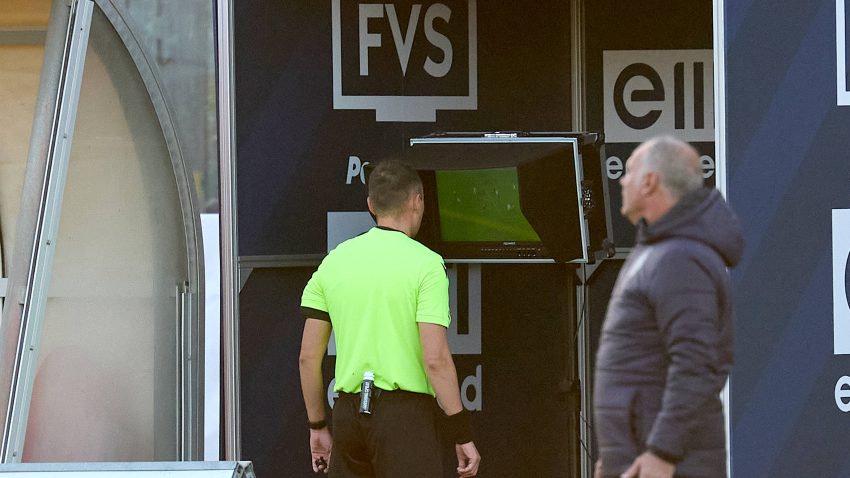
Clubs in the English Football League (EFL) have rejected fresh proposals to introduce a new form of video review that would allow head coaches to challenge on-field decisions by using a review card.
During a recent meeting involving EFL clubs, Professional Game Match Officials Limited (PGMOL), the body responsible for refereeing in English professional football, presented a demonstration of how the Football Video System (FVS) would operate.
Unlike the Premier League, the EFL — which includes 72 clubs across the Championship, League One and League Two — currently does not implement VAR technology.
Under the proposed FVS model, key refereeing decisions could be reviewed through video replay, but only if a head coach chooses to challenge the call by handing a review card to the fourth official.
However, unlike traditional VAR systems, the FVS would not rely on dedicated video match officials and would not automatically assess major match incidents.
Following their last clubs’ meeting, the EFL asked for feedback on the proposals and it became clear that the clubs do not support the implementation of any additional technology.
They currently use goal-line technology, which determines if a ball has fully crossed the line, and, as it stands, there is little appetite to go beyond that from a technological standpoint.
Goal-line technology will continue to be used in the Championship next season, while there is a formal vote in June to decide whether it will be adopted in League One.
Although FVS has been rejected at this juncture, that does not necessarily mean it cannot be implanted in the future.
There is currently no clear timeline for when the proposal may be revisited, and any future decision will ultimately rest with the clubs, although the English Football League has consistently maintained that it remains open to reviewing emerging technologies.
The Canadian Premier League has already been trialling the Football Video System (FVS), along with Arsène Wenger’s proposed “daylight” offside rule, since the start of its season in early April.
Under the FVS model, head coaches are permitted to challenge decisions involving goals or no-goals, penalty calls, direct red cards, and cases of mistaken identity.
In line with FIFA regulations, coaches must present the review card to the fourth official immediately after the incident in question to prevent unnecessary delays.
FVS is still not yet adopted in top major leagues like the Premier League, La Liga, or Serie A, but FIFA is actively expanding trials with the aim of wider future rollout.
The Football Video Support (FVS) system is still in a trial and rollout phase, so it is not yet used universally like VAR. However, several competitions and leagues have already adopted or tested it under FIFA/IFAB-led trials.
Leagues and competitions currently using or trialling FVS:
Canadian Premier League (CPL)
One of the first leagues to trial FVS in regular competition. Uses the coach “challenge” system for reviewing key incidents (goals, penalties, red cards, etc.).
Italy (Serie C – men’s third division) and Spain (Liga F – women’s top division)
One of the first top-flight leagues to adopt FVS. Used to support referees with coach-triggered reviews.
Brazil (selected competitions)
Trials have been carried out in domestic cup competitions, including women’s tournaments.
Australia (Australian Championship / selected competitions)
FIFA-selected trial environment for FVS. Used in playoff-style matches as part of controlled testing.
FIFA youth and international tournaments
Used in competitions such as: FIFA U-20 World Cups, FIFA U-17 and U-20 women’s tournaments. Serves as testing ground before wider domestic adoption.