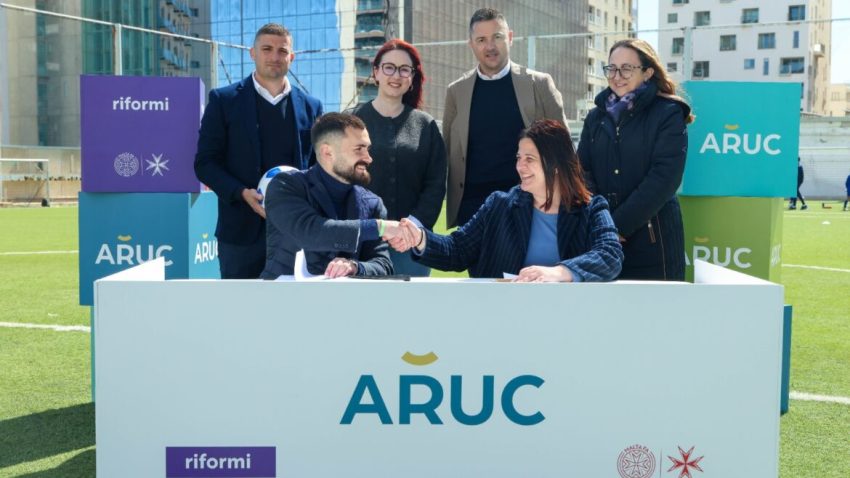
A newly launched agreement between the Malta Football Association and the Authority for the Responsible Use of Cannabis aimed at supporting around 160 children to access football nurseries has triggered a wider national debate around sport, policy coherence and symbolism.
The initiative will see children from socially and financially challenging backgrounds receive up to €250 each to attend football nurseries across Malta. Funding will be split with ARUC contributing 75 per cent and the MFA the remaining 25 per cent, with applications assessed by a dedicated committee.
From a policy standpoint, the scheme has been positioned as a social intervention. During the launch, Parliamentary Secretary for Equality and Reforms Rebecca Buttigieg described the agreement as part of a broader effort to promote sport as a healthy alternative to harmful habits, including drug use.
Similarly, ARUC CEO Joey Reno Vella framed the collaboration as a “practical and concrete initiative” that encourages healthier lifestyle choices while reinforcing prevention and education efforts already undertaken with Sedqa.

From the MFA’s perspective, Senior Vice President Matthew Paris highlighted the social dimension of the project, stressing that it will widen access to football for children who may otherwise be excluded.
Despite its social intent, the agreement has not passed without criticism. Among the most vocal was Andrew Azzopardi, Professor and former Dean within the Faculty for Social Wellbeing, who publicly questioned the optics and coherence of the partnership.
His argument centres on what he describes as a contradiction between football governance and anti-doping frameworks. Cannabis remains a prohibited substance in competition under the World Anti-Doping Agency code, raising concerns over the message being conveyed when a national sporting association collaborates with an authority linked to its regulation.
Azzopardi further argued that, if the intention was to promote social support or prevention campaigns, alternative partnerships could have been explored, including organisations such as Caritas Malta or different government funding channels. He also questioned the symbolism of the agreement, pointing to what he described as a contradiction between promoting “responsible use” messaging and enforcing anti-doping sanctions within football structures.
At the centre of the debate lies a broader question: can public health policy, harm reduction strategies and elite sport regulation coexist without contradiction?
ARUC’s remit is based on regulation, education and harm reduction rather than promotion of use. However, critics argue that in a sporting context where zero tolerance applies during competition, the partnership risks creating mixed messaging, particularly among young athletes.
Supporters of the initiative, on the other hand, emphasise its tangible benefits. The scheme directly lowers financial barriers to participation, potentially increasing grassroots engagement and providing structured environments for children who may otherwise lack access.