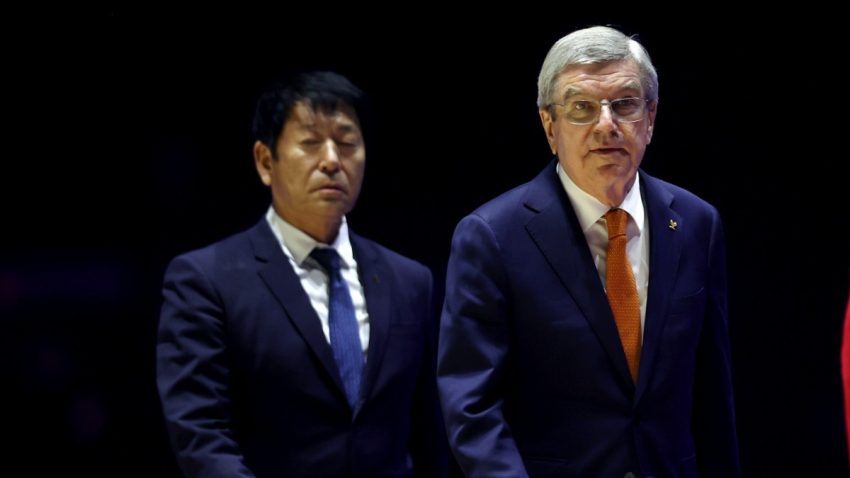
The Japanese candidate vying to succeed Thomas Bach as IOC president in March’s elections outlined his Olympic vision on Monday during a conference with AIPS members, proposing simultaneous Games in five continents, as well as addressing development, gender equality and peace through sport.
In an exclusive online call with International Sports Press Association (AIPS) affiliated journalists, conducted virtually from a gym in Kyiv, Ukraine, the current president of the International Gymnastics Federation (FIG) shared his proposal to spread the Olympic Games to five continents and also expressed his concern for the Ukrainian athletes amidst the ongoing war with Russia, setting an emotional tone on a human level from the outset.
Moderated by AIPS President Gianni Merlo, the interview allowed Watanabe to elaborate on his radical proposal for the Olympics. “The idea of holding them in five cities simultaneously, with ten sports in each, would be a complete overhaul. It’s not just about adding more disciplines, it’s a real revolution in Olympic competition,” he stated.
His vision aims to decentralise the event, reflecting his concern about the limited support for athletes in many parts of the world. “I have visited over 90 countries and seen that sport is present everywhere, but not with the same intensity or support. The Olympic Games should be a global reflection, not just a spectacle for a few,” explained Watanabe.
The proposal to spread the Games on an intercontinental level is also in line with a more inclusive approach, aiming for greater participation and global exposure. “The idea is that each continent would host ten sports and athletes would compete in countries with the best climate and infrastructure for each discipline,” he explained.
When asked about the logistical and financial challenges that his proposal might pose, including costs and the need for more sponsorship, Watanabe acknowledged these difficulties, but insisted that the benefits of making the Games more inclusive outweighed the challenges. “We need the support of the continental communities and this will be crucial for the future of the Games,” he said.
One of the more sensitive issues that Watanabe addressed was the inclusion of transgender athletes in sport, an issue that has caused controversy around the world in recent years. The official explained that while it’s a complicated issue, his approach will always be to balance inclusion with the protection of women’s rights. “The International Olympic Committee must embrace diversity, but we must also protect women’s rights. This is a principle we have to take seriously,” he underlined.
He also warned that more time and scientific evidence is needed before final decisions can be made on how to fairly include transgender athletes. “We don’t have a final position yet and we need more research to ensure that our decisions are based on science and respect for the rights of all,” commented Watanabe, who served on the IOC’s Women in Sport Commission (2018-2021) and Gender Equality, Diversity and Inclusion Commission (2022).
Gender equality was another key theme of the hour-long discussion. Watanabe expressed his firm belief that sports organisations have a lot to gain by putting women in positions to thrive, and a lot to lose if they don’t, stressing, “If we don’t put women at the forefront, these organisations will also lose their relevance.” This remark reinforced his stance on the need to promote gender equality in sport, which is a central focus of the 66-year-old candidate.
When asked by Inside The Games about supporting countries with fewer resources, Watanabe shared some personal experiences that had affected him. “When I visited the Philippines, I saw a young gymnast with incredible talent but no proper facilities. I decided to support him, brought him to Japan to train, and today he is winning Olympic medals,” he recalled.
This kind of support, he believes, is vital for the development of sport in countries with fewer resources. “Every country has its own challenges. Some have great athletes but lack facilities, while others have good infrastructure but lack the right coaches. We need to work together to solve these problems and help developing countries,” he explained.
Although he didn’t elaborate on how he would achieve this, he did offer a key phrase on strategies for the growth of underdeveloped countries in sport, “Stronger countries must help the weaker ones. We must work together for the good of sport,” he considered.

Throughout the online call, he also discussed governance within the IOC and the need to make it more democratic. “The use of technology will allow us to extend governance, to make it more open and accessible. A more inclusive IOC will be the one that adapts to modern times,” he mentioned.
He also stressed the importance of maintaining freedom of expression in the world of sport, which includes fair and open relations with the press. “The media are our free auditors, telling us what we are doing well and what we are doing wrong. Without the media, we could not improve,” he insisted, distinguishing himself from the current management, although he chose diplomacy by refraining from commenting specifically on how the current IOC operates on that front.
On the subject of doping, he answered AIPS president Merlo’s question firmly:,”This question shouldn’t even be asked, we have to be firm against doping”, he quiped, reminding that rigorous testing is the key to ensuring fair and clean sport.
On the future of Olympic prizes, Watanabe distanced himself from that idea. “I disagree with the IOC paying for prize money,” he said, basing his opposition on the differences between developed and developing countries. “Every country has different problems. Some have excellent athletes but lack facilities, while others have infrastructure but not enough talent,” he explained, pushing the need for a more global approach and cooperation between nations, but also stating that prizes are not the solution.
In summary, Watanabe made it clear that his vision for the future of the Olympic Games is ambitious and transformative, particularly with the proposal to decentralise the event, take it to five continents and expand the number of sports. His approach aims to make the Games more inclusive and accessible to a global audience, while helping developing countries and promoting peace through sport.
With a firm stance on the defence of athletes’ rights, gender equality and the fight against doping, he presented himself as a candidate determined to bring about significant changes within the Olympic movement. Although did not propose major innovations in the area of awards, he did advocate greater involvement of countries and sports in the organisation of the Games. However, his vision may meet with resistance in a historically conservative organisation, so it will be interesting to see how it is received by IOC members.