Dobromir Karamarinov, President of European Athletics, expressed his satisfaction with the evolution of the organization during the recent European Athletics Team Championships Division 1 in Madrid.
He credited former President Hansjörg Wirz for a transformative era that shifted the European Athletics Association (EAA) from an amateur setup to a professional body. Key milestones included relocating the headquarters from Darmstadt to Lausanne and legally reconstituting the association in Switzerland in 2003. The rebranding to “European Athletics” and adoption of a new constitution in 2005 marked the final steps in this evolution.

Karamarinov, involved since 1995 and a Council Member since 2007, recalled humble beginnings with only a handful of staff. He now sees a robust, modern organization leading continental athletics into the future.
“Since then of course we changed many things, but it was slight changes, more like improvements,” continues the EA President.
“My three priorities are Competition, Innovation and Community.
“Competition, because without competition we are dead! In 2020, during the COVID pandemic, we had to hold our annual Convention as an e-meeting, and I declared, ‘No more postponements, no more cancellations of competitions – we cannot survive without competitions,‘ and we did it! In 2021 we fulfilled our calendar: we held the European Indoors in Torun, Poland – yes, without spectators, with many restrictions – but we did it! And we also organised the U20 and U23 Championships – both in Tallinn, Estonia after Bergen, Norway had to withdraw. We were the only association to complete our competition calendar as scheduled. It was big challenge but challenges are also opportunities, and this challenge gave us the opportunity to learn more about our possibilities; for example, now we have more e-meetings, but we never gave up – there is always a solution.”
The other key priorities for the Bulgarian official are Innovation and Community.
“Innovation is key, because now in the modern world we have to be aligned with everything, and Community. European Athletics is not just the office in Lausanne, it is not just the EA Council or Executive Board; our community is mainly our 51 Programme Member Federations – currently 49 because of the situation – but I want to broaden our community, to include our partners, athletes, our athletes’ representatives, officials – this is our community.
“For example, I am very proud of two recent projects, Focus Federation Programme and Onboarding Programme.
“Focus Federation Programme is for those federations which do not have a Council member. Every two years, we invite delegation of three-four people from such federations to visit us in Lausanne for three days, speak with our staff. When they go back, they make a presentation from their federation to the EA Council – we want to bring the federations closer to us, and it is also useful for us to receive their feedback.
“The Onboarding programme is for newly-elected Presidents, General Secretaries or CEOs. We also invite them – two times per year, in spring and autumn, in groups of four or five – of course also at our cost. Newly elected top officials tell us this is so useful!”
WORKING CLOSELY WITH MEMBER FEDERATIONS AN EA TRADITION
The first time I became aware of European Athletics’ close work with their Member Federations was in 2012, when the association was staging its first continental championships in the new biennial format – a big challenge just five weeks before the Olympic Games.
Many people were sceptical that the EA could make this major change a success, but they were proven wrong – and the achievement came down to good preparation. European Athletics organised its first Communications Managers Seminar, where Member Federation media teams worked together on strategies to promote the competition.
“Federations working together. Communication, collaboration, to be together – that was a key point,” agrees President Karamarinov.
“The first two editions in Olympic years – 2012 in Helsinki and 2016 in Amsterdam – were successful, but not successful enough. Then the 2020 edition, scheduled for Paris, had to be cancelled due to the COVID pandemic.
“For Roma 2024 we really had to think how to improve it. I proposed to the EA Council – and they supported it in full – to introduce performance bonuses for the first time, and so we convinced the top athletes in Europe to compete.
“This was a game changer. In terms of TV viewers, Rome was an incredible success. For the first time in an Olympic year, we had the same viewers as Munich 2022 – which was part of a muti-sport event, in a non-Olympic year, and even lasted one day more than Rome.
“Of course we will continue with performance bonuses and even increase them in future, because it showed this was the right way to convince top athletes to take part.”
The success story continued in 2025, with an epic edition of the European Indoors in Apeldoorn in March, followed by a new event, the European Running Championships in April.
“Apeldoorn this winter was amazing,” agrees President Karamarinov. “It is always good that the host team are successful – it brings an incredible atmosphere.
“And the EA Running Championships (EARC) were excellent. We have to be innovative, we have to find the space where can do something more for our runners, because running middle and long distances is not the best in Europe. But this is also a competition which could bring good revenue for European Athletics.
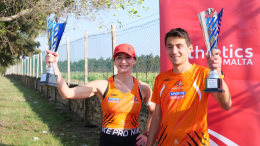
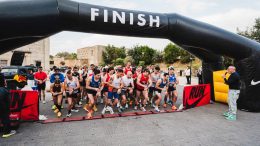
“Some key people in the running community came to me after the event and said, ‘We didn’t believe it before, but now we can say it was great.’ And it was great! More than 28,000 runners competed. The previous record was less than 10,000, less than 10,000! And suddenly 28,000. It was a big, big, success. We expected a successful championships, because we prepare all our events very professionally, but such a success was really a very big surprise. And we already assigned the next two editions of these biennial championships.”
One of the key innovations of the EARC was the possibility for club runners to compete at the same time as the elites, and to score points for their team. There was just one incident in the Women’s Marathon, where Spain’s Fatima Ouhaddou fell after colling with a club runner at a drinks station, but she got up and went on to win the race.
“This was the key innovation,” says President Karamarinov, “to bring amateur runners together with the professionals, and give amateurs the chance to bring points to their team. If they run well, they contribute to their team and have right to run with the national vest. This was really a great source of pride for them, that they could run with the elite and be part of the team, part of their nation.