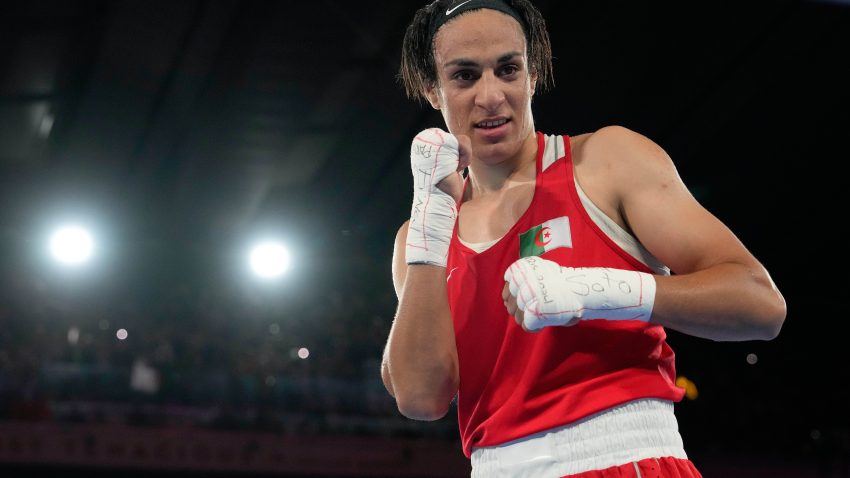
World Boxing, the newly accredited international federation for the sport, has stirred controversy after announcing it will implement mandatory genetic sex testing beginning 1 July. The move, announced on Friday, marks a significant shift more than two years after the gender eligibility saga first erupted at the 2023 IBA World Championships and nearly a year after the Paris 2024 Olympic Games spotlighted the issue.
The decision, World Boxing said, was driven by concerns for the safety and wellbeing of all athletes, including Olympic gold medallists Imane Khelif of Algeria and Lin Yu-Ting of Taiwan. Both fighters had been cleared by the International Olympic Committee (IOC) to compete in the women’s division in Paris despite prior test results from the now-sanctioned International Boxing Association (IBA) suggesting they had male chromosomes.
World Boxing’s announcement comes amid renewed focus on those controversial tests, following the publication of previously unreleased 2023 lab results from Dr Lal PathLabs in New Delhi. The findings, referenced in an article by American journalist Alan Abrahamson, reportedly confirm the presence of a male karyotype in Khelif’s case—information that had been kept from the public eye until now.
During the Paris Olympics, the IOC had dismissed the IBA’s conclusions, citing flaws in the testing process and defending its athlete passport approach for determining eligibility. “The whole process is flawed,” IOC spokesman Mark Adams said at the time, while President Thomas Bach insisted the matter had no relation to transgender participation. The IOC barred the IBA from Olympic recognition in 2023 over governance issues, leading to the rise of World Boxing under the leadership of Boris van der Vorst.
Van der Vorst had previously attempted to steer clear of the gender debate, supporting the IOC’s handling of the Games. However, as World Boxing seeks to establish credibility ahead of Los Angeles 2028, its sudden alignment with sex testing protocols and the IBA’s earlier position suggests a more assertive stance.
The debate over Khelif’s eligibility has extended far beyond the ring. Following her Paris triumph, Khelif became the subject of widespread media attention and online harassment, prompting her to take legal action. Her name later surfaced in a political video by Donald Trump opposing transgender athletes in women’s sports. Meanwhile, a report by French journalist Djaffar Ait Aoudia claimed to have accessed medical records indicating that Khelif has XY chromosomes, no uterus, and a rare condition known as 5-alpha reductase deficiency.
The IBA, now sidelined, maintains that its approach to competition, separating male (XY) and female (XX) athletes, is based on protecting health and fairness. Its assertion that five boxers, including Khelif, were found to have XY chromosomes has yet to be formally challenged by the IOC, which maintains it followed proper protocols during Paris 2024.
World Boxing’s move comes as pressure mounts internationally. A report submitted to the 79th UN General Assembly by special rapporteur Reem Alsalem called for sex testing in elite sport, arguing it is “necessary, legitimate and proportionate” in certain contexts. Alsalem specifically cited the Paris boxing events as an example of why testing should be enforced, while acknowledging that her recommendations were non-binding.
As outgoing IOC president Thomas Bach prepares to hand over to Kirsty Coventry on 23 June, the issue remains unresolved. Bach recently suggested the entire controversy was amplified by a Russian disinformation campaign. Coventry, who will inherit a growing number of gender-related disputes in sport, has yet to comment on World Boxing’s decision.
Whether this marks a turning point in the regulation of sex and eligibility in international boxing, or merely the start of a new chapter in an already convoluted saga, remains to be seen. But after years of ambiguity and silence, World Boxing has finally thrown its first official punch.