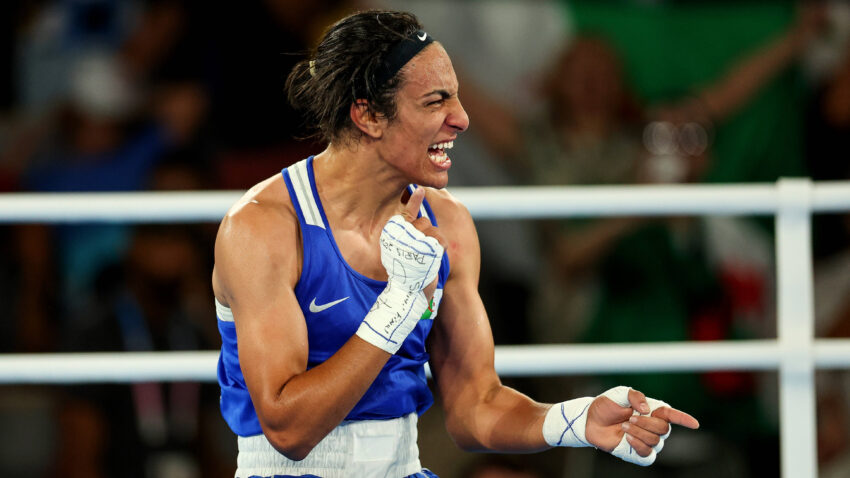
Olympic boxing has been at the center of a controversy that calls into question fairness and safety in women’s sports. Imane Khelif, an Algerian boxer and gold medalist at the 2024 Paris Olympics, has been questioned about her eligibility in the women’s category due to chromosome test results indicating the presence of XY markers, typical of a male karyotype.
As reported on Sunday by ‘3 Wire Sports’, World Boxing, the international boxing federation, has announced that Khelif will have to undergo mandatory chromosome testing to determine her eligibility in the women’s category. According to the federation -and the ‘3 Wire Sports’ exclusive information-, these tests, known as PCR, can be performed with a simple mouth swab and are capable of identifying the presence of the Y chromosome, an indicator of biological sex. This measure seeks to ensure the safety of female athletes in combat sports, where biological differences can pose significant risks. This decision is even more significant considering that the IOC has placed its trust (provisionally) in World Boxing to organize the boxing tournament for the upcoming 2028 Olympic Games in Los Angeles.
Previous results and the IOC’s position
In world championships organized by the International Boxing Association (IBA) in 2022 and 2023, tests performed on Khelif and another boxer, Yu Ting Lin of Chinese Taipei, revealed XY markers and testosterone levels typical of males. Despite these results, the International Olympic Committee (IOC) allowed both to compete in Paris, arguing that eligibility should be based on the gender identity stated on the passport.
The IOC described the IBA’s tests as “not legitimate” and questioned both the method and the process. To provide context, these tests were conducted in accredited laboratories, such as Dr. Lal PathLabs in New Delhi, which is certified by ISO and the College of American Pathologists. The IBA defended its decision as a response to changing conditions during the championships. The test proves that the decision of the IBA CEO this time wasn’t arbitrary, as the IOC mentioned.
Differences in sexual development and their impact on Sport
According to a medical report cited by French media, Khelif has been diagnosed with type 2 5-alpha reductase deficiency—a rare condition characterized by XY chromosomes, the presence of internal testes, and testosterone levels significantly higher than those typically found in women. In high-performance sports, particularly in contact disciplines like boxing, such physiological attributes can offer a competitive advantage.
This development coincides with new eligibility regulations introduced by World Boxing, which gained provisional recognition in 2025. These regulations, based on chromosome testing, are set to take effect on July 1. Nevertheless, Khelif has already been excluded from participating in the Eindhoven Box Cup, scheduled before the rules officially come into force.
The Ongoing Debate: Identity vs. Biology in Sport
The International Olympic Committee’s 2021 framework on inclusion and non-discrimination emphasizes that athletes should compete in the category that aligns with their gender identity. While it allows for performance evaluations, it explicitly prohibits sex-determination testing. This stance prioritizes gender identity over biological factors, generating ongoing debate in sports where physical attributes may significantly influence outcomes.
Beyond the scientific and regulatory aspects, ethical considerations—such as the responsibility to set societal standards—add further complexity to this already sensitive issue.
With World Boxing set to oversee the boxing competition at the 2028 Los Angeles Olympics, the question of eligibility in women’s categories remains a pressing topic. Khelif’s exclusion and the introduction of chromosome-based rules may mark a turning point in how international sport addresses inclusion and fairness.
Another emerging question is the status of past medals: if the current trajectory continues, will previous awards be reassessed or revoked? This could become the first major challenge under the leadership of new IOC President Kirsty Coventry.