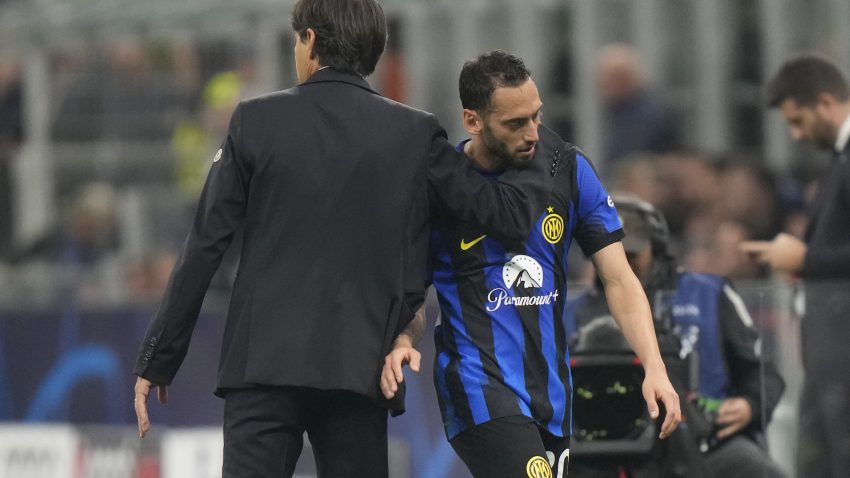
Inter Milan manager Simone Inzaghi and midfielder Hakan Calhanoglu have each received a one-match suspension and financial penalties after accepting a plea deal in an ongoing investigation into unauthorised contact between professional football figures and extremist supporter groups.
The case, which has come to be known as the “Inchiesta Curve,” has spotlighted the ties between Serie A clubs and ultras, the often controversial fan organisations that dominate stadium culture in Italy.
The disciplinary action results from a broader inquiry launched by the Italian Football Federation, FIGC, following criminal arrests made by the Milan Public Prosecutor’s Office in September 2023. That operation dismantled the leadership of ultra factions connected to both Inter Milan and AC Milan. Following the arrests, federal investigators requested access to the case files to determine whether players, managers, or club officials had developed improper relationships with unaffiliated supporter groups.
Simone Inzaghi and Hakan Calhanoglu were charged with breaching FIGC’s Code of Sports Justice, specifically Article 4, which relates to integrity and fair conduct, and Article 25, which forbids any relationships with fan groups not officially affiliated with the club. The FIGC prosecutor, Giuseppe Chinè, offered both men the opportunity to reach a plea agreement, which they accepted. This allowed them to avoid a full disciplinary hearing, and as a result, both received reduced sanctions. Inzaghi admitted to attempting to mediate on behalf of an ultra leader by contacting the club directly, while Calhanoglu acknowledged having personal contact with individuals known to hold influence within the curva, including figures previously advised against by Inter.
The consequences for the club did not stop with its coach and key midfielder. Inter Milan has also been fined under the federation’s rule of objective responsibility, which holds clubs accountable for the actions of their representatives. Club vice-president Javier Zanetti had his initial suspension converted into a financial penalty. Additionally, the head of club security and the team’s supporter liaison officer were each sanctioned with temporary suspensions and fines, reflecting their involvement in the management of fan relations.
AC Milan has also come under scrutiny in the inquiry. The club was fined for objective responsibility, and its supporter liaison officer was handed a suspension. Former club captain Davide Calabria, now playing for Bologna, has not accepted a plea deal and is expected to be interviewed again by investigators in the coming days. Calabria has admitted to meeting with an ultra leader from Milan’s curva, but has stated that the discussion focused solely on team performance and dressing room matters. His decision to reject a plea bargain suggests that he intends to formally contest any disciplinary proceedings brought against him.
One of the most serious allegations in the early stages of the investigation concerned the possibility that tickets for the 2023 Champions League final had been distributed to ultra leaders by Inter Milan. However, federal prosecutors have confirmed that no evidence has emerged to support this claim. Milan’s chief prosecutor, Marcello Viola, has formally designated Inter as a damaged party in this aspect of the case, clearing the club of wrongdoing in relation to the ticketing matter.
The Inchiesta Curve has stirred deep concerns within Italian football about the influence of ultras on club operations and decision-making. While such supporter groups are often credited with creating the vibrant and passionate atmosphere in Serie A stadiums, they have also been linked to violence, intimidation, and off-pitch interference. The investigation marks a turning point in how the sport’s governing bodies are choosing to confront the delicate balance between club loyalty and institutional independence.
The FIGC’s firm application of its ethical code signals an intention to reinforce boundaries and hold individuals accountable, even in cases where no criminal charges are brought. The principles of loyalty, fairness, and detachment from unauthorised influence are being emphasised as essential to maintaining the integrity of the sport. With more hearings expected and the possibility of further sanctions still open, the Inchiesta Curve is unlikely to fade quickly from the Italian football landscape.