The Italian Government’s minister of Infrastructure and Transport again expressed this week his optimism regarding the pace at which the preparations for the 2026 Winter Olympic Games are advancing, and also emphasised the relevance that the multi-sport event will have in terms of tourism.
“At the Milano Cortina Games, which I have the honour of supporting, we are making up for all delays, and I am counting on the volunteers, mayors, and enthusiasts to make it an extraordinary moment not only for Lombardy but for all of Italy,” stated Matteo Salvini at Palazzo Lombardia in Milan. The minister stressed the importance of the spectacle, which will be watched by three billion people worldwide, and remarked, “If only 1% of them come to Italy as tourists after seeing our mountains, we will have done a good job.”
Less than a year before the opening ceremony, the Government and the company responsible for the infrastructure assure that everything is progressing without setbacks, although the opposition and civil organisations report significant delays and a lack of transparency. At the same time, security operations have been intensified, with anti-terrorism drills at train stations to ensure the safety of attendees and athletes during the event.
According to the citizen monitoring report from Open Olympics 2026, less than 10% of the infrastructure has been completed, and nearly half of the projects have not yet started. Additionally, they claim that six out of ten initiatives have not undergone environmental impact assessments and that a third of the works will be completed after the Games, between 2026 and 2032.
These figures have sparked a strong political reaction in Italy, with the Greens demanding explanations in Parliament. “The Government cannot continue promoting a triumphalist narrative when the data shows that investment priorities are unbalanced and that essential projects have not even begun,” criticised Luana Zanella, leader of the Left Green Alliance group.
For its part, Società ‘Infrastrutture Milano Cortina 2020-2026’ (Simico), the entity responsible for planning and executing the works, denied any delays and described the accusations as “an unacceptable manipulation”, assuring that all was going according to plan. “The construction of the sports facilities is progressing fully in line with the scheduled deadlines (in some cases ahead of schedule) and will be completed before the Games,” the company stated in a communiqué. “Suggesting otherwise is not only false but entirely defamatory.”
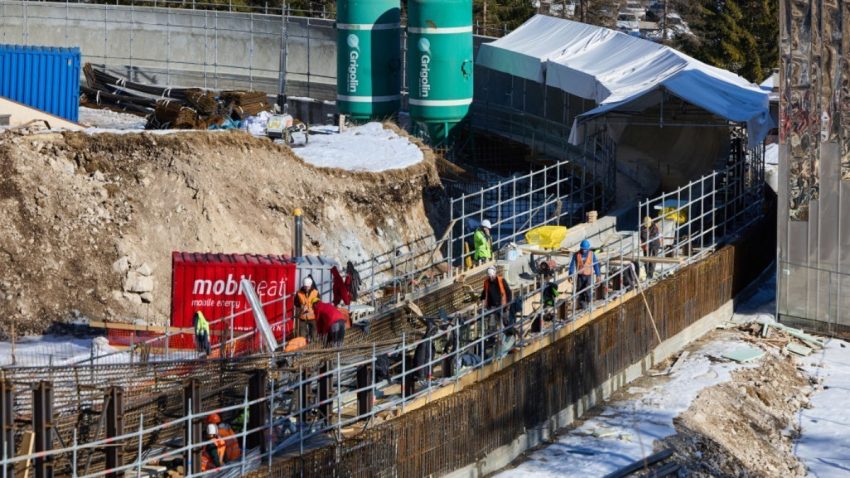
Simico further explained that the alleged delay in six projects is due to a reorganisation carried out in November 2024 and emphasised that “environmental data is constantly monitored, and the company’s actions fully comply with current regulations.” One of the most controversial points is the construction of the Cortina ice track, essential for bobsleigh, luge, and skeleton events. Although some reports indicate that the project is at risk, Simico assured that the infrastructure will be approved in the coming weeks and will be ready on time.
In terms of connectivity, a key project is the improvement of the railway corridor between Milan and Verona, which will facilitate access to the Games and optimise transport between venues. The modernisation of the road network in the Alpine region is also part of a plan to combine logistical efficiency with environmental sustainability. However, critics argue that spending on roads and railways is 5.6 times higher than spending on sports infrastructure, resulting in higher overall costs.

The political debate in the Mediterranean country intensified in recent hours. “It has always been known that some roadworks would begin after the event because they are a legacy for the region. This is nothing new, and using it as an argument against the project is dishonest,” argued a Government spokesperson.
Meanwhile, Open Olympics 2026 remains firm and has called on the Milano Cortina 2026 Foundation to follow Simico’s example in terms of transparency. “Our intention is not to hinder the work but to ensure that the principle of access to information is respected and that investments are justified,” the organisation stated in a press release.
As the political debate continues to grow, authorities are reinforcing security drills ahead of the Olympic event. On Saturday night, an anti-terrorism simulation was conducted on a ‘Frecciarossa’ train at the entrance to Milan Rogoredo station. During the exercise, promoted by the Ferrovie dello Stato Group, a suitcase containing ammonium nitrate was simulated to explode in the second carriage, immediately activating emergency protocols.