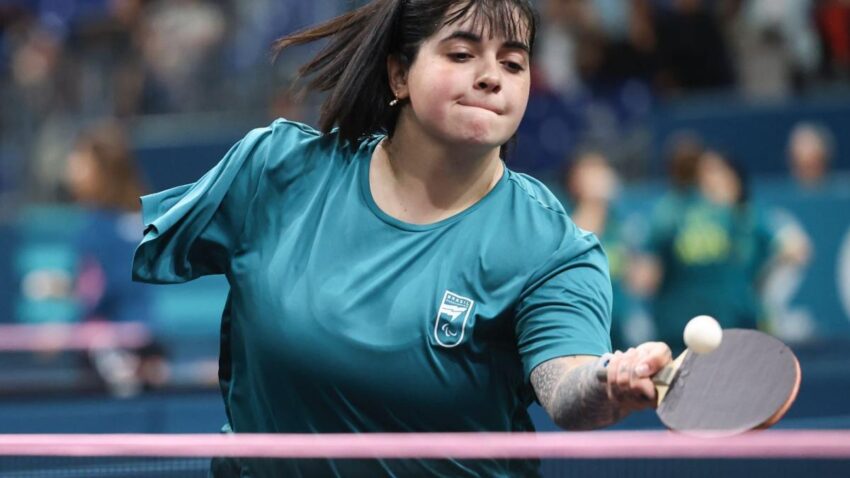
For the past month, Brazilian Para table tennis player Bruna Alexandre has been asked constantly about what it means to make history. In Paris, she became the first athlete from Brazil to play at both the Olympic and Paralympic Games in the same year.
The 29-year-old athlete says it was a dream come true to compete at two Games in as many months, giving her a platform to share a message with sport fans around the world.
“Now I finally conquered this dream,” said Alexandre, who is competing at her fourth Paralympic Games. “It was important for me to be here (in Paris) for the Olympics, not only as an athlete, but also as a person with a disability. I think it’s important to show that people can be included in any environment.”
“This is going to change things not just in Brazil, but in the world in terms of perception that people have on persons with disability.”
From Olympics to Paralympics
Alexandre, who lost her right arm after developing a blood clot when she was still a baby, has been playing table tennis for more than 20 years. “Table tennis is my life. I started the sport when I was around seven years old, so for me, I dedicate my life to this sport.”
She is now a four-time Paralympian and a five-time Paralympic medallist.
Preparing for the Olympics and Paralympics, however, involved a different process, the table tennis athlete shared. She concentrates on different parts of the game, because they require different skillsets.
“My main challenge for preparing for the Olympics was to understand how to play against people that don’t have any problem with balance,” she said. “Olympic players have two arms, so they don’t have any problem with balance. I had to rethink my way of playing.”
“And now I’m still trying to get back to the way I play at the Paralympics. It’s about changing the mindset and how the body works during competition,” she said.
Despite the differences, she did not see it as a disadvantage when she competed in the women’s team event at the Paris 2024 Olympic Games.
“The difference is normal and at the Olympics, the level is very high when we talk about athletes coming from Asia like China, Japan and Korea.
“I don’t think this is a disadvantage – I think this is really good because it challenges me, and it will help me improve my skills to be able to be a better Paralympian as well.”
Dreams in Paris
At the Olympic Games, Brazil were knocked out in the first round by powerhouses South Korea. Looking back, she says she gained much more than what the scoreboard shows.
“I knew we didn’t have a big chance but we tried to enjoy the moment and to challenge my own skills,” Alexandre said. “The French fans tried to help us, supporting Brazil against Korea. We lost but it was a great experience.”
“I loved the support of the French people. I loved the arena and how they staged the competition. The French people were chanting my name.”
And now she is looking for French fans to support her at the Paralympic Games. She is competing in three events – women’s singles WS10, women’s doubles WD20 and mixed doubles XD17 – in Paris.