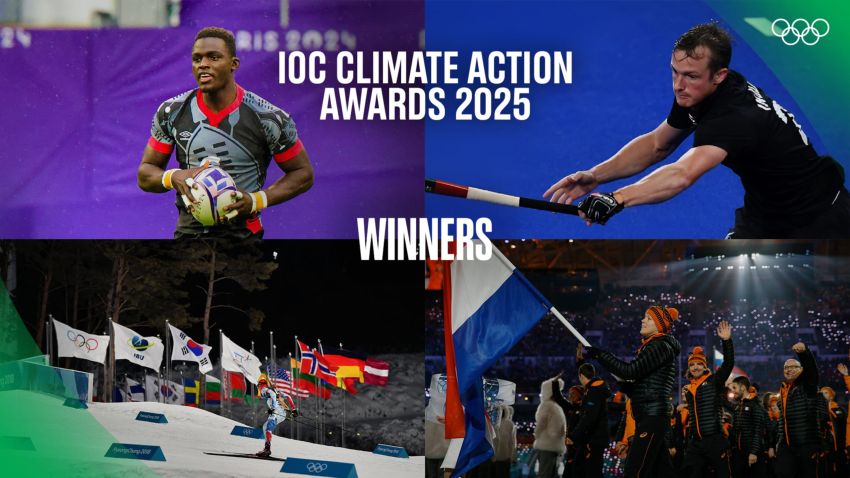
The International Olympic Committee (IOC) has announced the winners of the 2025 Climate Action Awards. The announcement was made during the IOC Session in Milan, ahead of the Milano Cortina 2026 Olympic Winter Games.
The awards recognise athletes, national committees, and international federations for their efforts to address climate change and make sport more sustainable. Winners include New Zealand hockey player Hugo Inglis, Kenyan rugby sevens player Kevin Wekesa, the Netherlands Olympic Committee (NOC*NSF) and the International Biathlon Union (IBU).
IOC President Kirsty Coventry said, “As athletes, we learn early on to focus on what we can control and to keep pushing and adapt, even when conditions are not perfect. That spirit is exactly what drives the IOC Climate Action Awards. Our winners are showing that protecting our planet and pursuing excellence can go hand in hand. Their work shows the impact of the Olympic community when it leans in together with purpose. What an inspiration.”
Athlete Winners
Hugo Inglis (Hockey, New Zealand)
Hugo Inglis co-founded High Impact Athletes (HIA), a global movement that channels athlete visibility and resources towards evidence-based climate solutions. HIA brings together more than 240 athletes from 50 disciplines and 35 countries and has directed over USD 2 million to charities in the areas of climate, global health and animal welfare.
Inglis has promoted sustainable living through eco-conscious travel, a plant-based diet, and a car-free lifestyle. HIA aims to scale further, providing up to 600,000 athletes with opportunities to fundraise for climate solutions.
Kevin Wekesa (Rugby Sevens, Kenya)
Kevin Wekesa founded Play Green, a programme that uses sport to promote climate action in Kenya. The initiative has replaced nearly 1,000 single-use plastic bottles per week with reusable aluminium bottles for national rugby teams.
Play Green also incorporates climate education in 40 schools through tree planting, water conservation workshops, and waste management programmes. To date, 2,300 trees have been planted, and thousands of children have participated. Kevin plans to expand the programme nationwide with plastic-free stadium zones, biodegradable packaging, and a Green Ambassador initiative in schools.
National Olympic Committee Winner
NOC of the Netherlands (NOC*NSF)
The NOC*NSF has implemented a sustainable mobility strategy to reduce emissions from athlete and staff travel. Electric vehicles, e-bikes, and a digital mobility platform have been integrated into the system, resulting in a 40 per cent reduction in emissions. Full electrification is planned by 2027.
Sustainable procurement practices have also been applied. For the Paris 2024 Olympic Games, clothing emissions fell from 206.7 tonnes of CO₂ at Tokyo 2020 to 60.9 tonnes, a reduction of more than 70 per cent. These measures set a benchmark for long-term environmental impact in sports operations.
International Federation Winner
International Biathlon Union (IBU)
The IBU has developed a climate strategy covering competitions, operations, and community engagement. It is the first Winter International Federation to include World Cups and World Championships in a climate transition plan, achieving a 6 per cent reduction in emissions across all three scopes of the Greenhouse Gas Protocol in 2024.
Through the Athlete Ambassador Programme, 26 athletes from 17 countries lead campaigns and engage fans. The Biathlon Climate Challenge has mobilised 12,000 fans to participate in climate-positive activities, planting 150,000 trees in Sub-Saharan Africa. The IBU aims for a 50 per cent emissions reduction by 2030 and net zero by 2040.
Highly Commended
NOC of Spain (COE) has reduced emissions by nearly 28 per cent since 2018 and developed the Sustainable Sports Seal, certifying events and organisations for environmental, social, and economic standards.
World Sailing has implemented data-driven emissions reductions for support vessels, cutting fuel use and emissions by over 20 per cent at the Paris 2024 Olympic Games. Efficiency standards and eco-piloting training aim to reduce the carbon footprint of sailing events.
The 2025 Climate Action Awards highlight the Olympic movement’s commitment to sustainability, demonstrating measurable and scalable solutions across athletes, national committees, and federations.