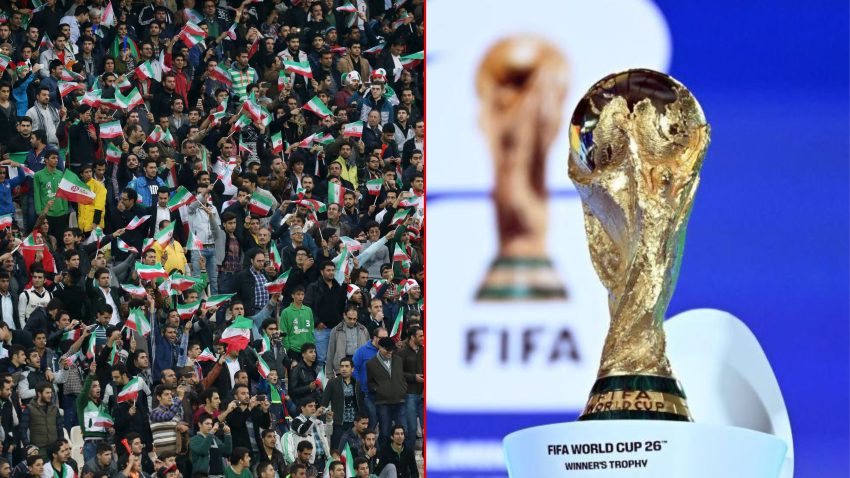
FIFA Secretary General Mattias Grafström has confirmed that the world football governing body is monitoring the escalating conflict between the United States and Iran, but stressed that preparations for the 2026 World Cup remain focused on delivering a secure tournament for all qualified teams.
The United States and Israel carried out missile strikes on Iran on 28 February. The strikes were described by President Donald Trump as a “major combat operation.” In response, Iran launched attacks on US air bases in the Gulf, including facilities in the United Arab Emirates, Qatar, Kuwait and Bahrain.
Iran has qualified for the 2026 World Cup, which will be co-hosted by the United States, Mexico and Canada. The national team was drawn in Group G alongside Belgium, Egypt and New Zealand. According to the current schedule, Iran is due to play two group matches at SoFi Stadium in Los Angeles on 15 and 21 June and one match at Lumen Field in Seattle on 26 June.
Speaking at the International Football Association Board annual general meeting in Cardiff, Grafström said that discussions had taken place regarding the situation, but he described it as too early to provide detailed comment.
“I read the news (about Iran) this morning the same way you did,” he said. “We had a meeting today and it is premature to comment in detail, but we will monitor developments around all issues around the world. We had the finals draw in Washington in which all teams participated, and our focus is on a safe World Cup with all the teams participating. We will continue to communicate as we always do with three [host] governments. Everybody will be safe.”
The diplomatic context includes travel restrictions affecting Iranian nationals. Iran is among 19 countries placed under a “full suspension” category within the expanded United States travel ban. Exemptions, however, apply to athletes, coaching staff and their immediate relatives travelling for the World Cup, Olympics or other major sporting events. FIFA has introduced a dedicated World Cup visa, the FIFA Pass, which does not override existing travel restrictions.
The Iranian Football Federation president, Mehdi Taj, has previously warned that some players and staff could face visa issues due to prior military service. Several national team members have served in the Islamic Revolutionary Guard Corps, designated by the US government as a foreign terrorist organisation. The US State Department has not ruled out possible visa refusals.
Following reports that US and Israeli strikes had killed Iran’s Supreme Leader, Ayatollah Ali Khamenei, Taj publicly questioned Iran’s participation in the tournament. Speaking to Iranian television, he said: “Given what happened today and this US attack, it is unlikely we can look forward to the World Cup, but the final decision must be made by the relevant sports authorities.”
Iran is scheduled to play New Zealand at SoFi Stadium in Los Angeles in 107 days. Under FIFA rules, a team that withdraws before the competition may be replaced, typically by the highest-ranked non-qualifier from the same confederation. Speculation has included the United Arab Emirates and Iraq, although no formal decision has been announced.
Regional instability has already affected other sporting events. Bahrain reported attacks on military facilities hosting US forces, while Qatar, Kuwait and the United Arab Emirates temporarily closed airspace following Iranian bombardments. The Qatari government postponed all tournaments and competitions, including the Finalissima between Spain and Argentina, originally scheduled in Lusail on 27 March. The Asian Football Confederation has also postponed Asian Champions League Elite matches in the Middle East.
Other events under review include the Euroleague ‘Next Generation’ under-18 tournament in Abu Dhabi and motor sport events in Qatar, Bahrain and Saudi Arabia.
FIFA has stated that operational planning for the 2026 World Cup continues. Security coordination remains ongoing with the three host governments as geopolitical developments unfold.